




Aluminum cross-sections (profiles) for the manufacture of frames are produced by various companies in a wide variety of shapes, dimensions and weights (each manufacturing company has patented its own type of cross-sections). Production takes place in series of specialized cross-sections intended for the manufacture of predetermined types of frames (ie doors or windows of a specific form and function, heavier or lighter type). An aluminum frame is assembled from cross-sections of a certain series and, as a rule, a frame cannot be made from cross-sections of different series or different companies. Aluminum frames are very light, but show less impact resistance than iron ones, due to the hollow configuration of the cross-sections and their relatively small thickness. Two important characteristics of the material that have an impact on the behavior of the frame are the high thermal conductivity and the high coefficient of thermal expansion.
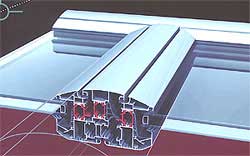
The thermal conductivity of aluminum is three times that of steel. Therefore, significant heat losses are created through the cross-sections of the aluminum. A result of the high thermal conductivity are the very cold (during the winter) surfaces of the cross-sections which favor the intense condensation of water vapor on their surface. In order to solve the problem of the low thermal resistance of the common cross-sections, special cross-sections can be used which are interrupted (the inside from the outside part) by the insertion of synthetic heat-insulating material (heat-breakable profiles).
The large coefficient of thermal expansion leads to intense movements of the frame and leaf, especially in large-sized frames. Therefore, in the latter case, appropriate expansion joints must be provided. In addition to its natural color, it can easily be colored with various and impressive organic colors, unchanged by light and atmospheric corrosion by electrostatic painting.
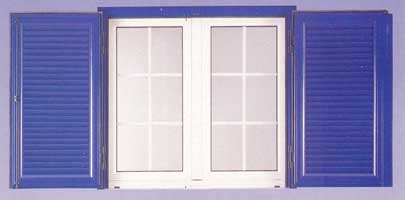
The simplicity of applying aluminum in the construction of the frames and the wide variety of construction cross-sections (profiles) and components offered by the production companies, allow aluminum frames, in addition to their great solidity and mechanical resistance, to ensure much better tightness in air and water, from all other frame production materials.
Characteristics of Aluminum Frames The surfaces of the cross-sections are not painted like wooden or iron cross-sections, but are treated with anodic oxidation before the frames are assembled. The layer of alumina created by the anodizing treatment is very hard, impervious to water, air and other chemical media. The anodization is done by the electrolysis method in special facilities. Lately, other methods of painting aluminum have been applied, such as electrostatic painting (again in special facilities and before assembly). With electrostatic painting, a wide variety of cover colors are achieved that have stability, great adhesion and significant scratch resistance. This relatively new application in the appearance of aluminum, which can practically give any color and not a transparent metallic shade, increased the preference for using aluminum frames. Aluminum frames are prefabricated, modular constructions with visible joints at the connection points (as opposed to wooden or iron ones). The possibilities of compositional freedom and processing of the form of aluminum frames are generally more limited compared to iron and wood due to the standardized production of cross-sections for specific types of frames. The curvature of the cross-sections is very difficult, so aluminum frames with curved shapes are rarely used.
Today, all types of frames (i.e. opening, sliding, retractable, folding, etc.) are made with the corresponding aluminum cross-sections. Regarding the installation of the glass panes, the same applies as for the wooden and iron frames, but the following points must be observed: - The slats (aluminium) for fixing the glazing are snap-on, which means that we have to use the appropriate slat and the appropriate elastic cross-section for the different thicknesses of the glazing.
- In large frames, the glass panes must be fixed in an elastic manner and at the appropriate distances from the frame, so that there is no risk of breaking due to the strong contractions and expansions of the frame. Aluminum frames generally have a very good behavior in terms of windproofness and watertightness due to the possibility of very good application of frame and sheet. The aluminum cross-sections can be easily shaped to have an efficient water drainage system and suitable notches for the easy installation (and replacement) of rubber windproof seals
color charts
Aluminum profile manufacturing companies EUROPA, ALUMIL, ETEM, etc. , have profiles in a wide variety of color shades, thus allowing the consumer to choose not only an innovative, timeless, functional aluminum system, but also an aluminum system that stands out for its color vibrancy, its natural appearance and its absolute resistance to corrosion , light and temperature. Combination of aluminum and wall colors Choose colors for your frames from a wide range offered by Fenestral